OFTEN described as the John Magnier of trotting, Jean-Pierre Dubois is renowned throughout the world… except in Britain and Ireland.
Yet he is also a major force in both flat and National Hunt racing in Europe, from Sparkling Plenty to Salvator Mundi. And with his stallion Chachnak, he may well be pulling off one of the greatest coups of his extraordinary career.
In 1944, France was under German occupation. Across the country, people were exhausted by the war. With fuel in desperately short supply, horses remained one of the main means of transport. In the town of Dinan, in the heart of Brittany, a four-year-old boy made the local headlines. His name? Jean-Pierre Dubois.
The youngster spotted a horse-drawn cart in the yard of the family farm. He climbed aboard and released the brake. What followed was a wild ride through the streets of Dinan, while his parents desperately chased after the runaway cart, all under the watchful eyes of the German occupying forces.
A childhood without money
The Dubois family were poor farmers in one of the poorest regions of France. After the war, Jean-Pierre’s father, who combined farming with training racehorses, moved the family to Normandy, where they lived in a house with neither running water nor electricity.
There was endless work on both the cattle and with the horses. As a result, young Jean-Pierre left school at an early age. His father tried to make ends meet by trading both trotters and thoroughbreds.
By the age of 13, in 1953, Jean-Pierre had already won his first trotting race “against adults”. Two years later, he turned professional. At the age of 18, he left the family farm and set up on his own as a trainer in Marseille, on the opposite side of France.
Explaining this remarkably early career choice, the man who had been crowned France’s champion apprentice in 1955 says with characteristic irony: “When I lost my apprentice status, I found it much harder to win races. That annoyed my father, who advised me to go and try somewhere else… I wasn’t particularly talented.”
On a more serious note, Dubois adds: “My father was incredibly passionate about horses. But we were desperately poor and he struggled enormously just to keep his little stable alive.”
Escaping poverty
Two decades of hardship followed, with a few highs but many more lows, for the young man who had started with no money and only a handful of inexpensive horses picked up here and there. That is why one of his favourite sayings is: “Always remember to greet people on your way up the stairs, because you’ll meet them again on the way back down.”
His breakthrough came at the very end of the 1970s with a trotter named High Echelon, purchased at the dispersal sale of Constantin Goulandris’ stock. The horse was already five years old and had been racing for several seasons. But Dubois had spotted something special.
Somehow, thanks to a client his father had met on a plane, he managed to raise the equivalent of around €40,000 in today’s money to buy him. It proved to be a masterstroke.
High Echelon went on to win the 1979 Prix d’Amérique - the trotting equivalent of the Prix de l’Arc de Triomphe - at the extraordinary odds of 82/1. Naturally, this opened the doors of the breeding shed, where he became a perfectly respectable stallion.
Dubois recalls: “High Echelon got me out of poverty and allowed me to start building a business. I was lucky because his first trainer hadn’t worn him out. The change of environment, the fact that he spent so much more time in the paddock, completely transformed him.”
In 1982, Jean-Pierre Dubois won the Prix d’Amérique again. Once more, it was an audacious gamble. When he bought Hymour, the horse had been standing at stud for two years after suffering leg problems, having previously been one of the best three-year-olds of his generation. To bring him back to racing, Dubois based him at Cagnes-sur-Mer on the Mediterranean coast.
In races, he completely reversed the tactics employed by the horse’s previous connections. Rather than forcing him into the early pace, he was happy for Hymour to settle at the back before unleashing his devastating turn of foot in the closing stages. The strategy worked perfectly.
Hymour won the 1982 Prix d’Amérique. By then, Jean-Pierre Dubois was in his 40s, and it finally seemed as though the years of struggle were behind him.
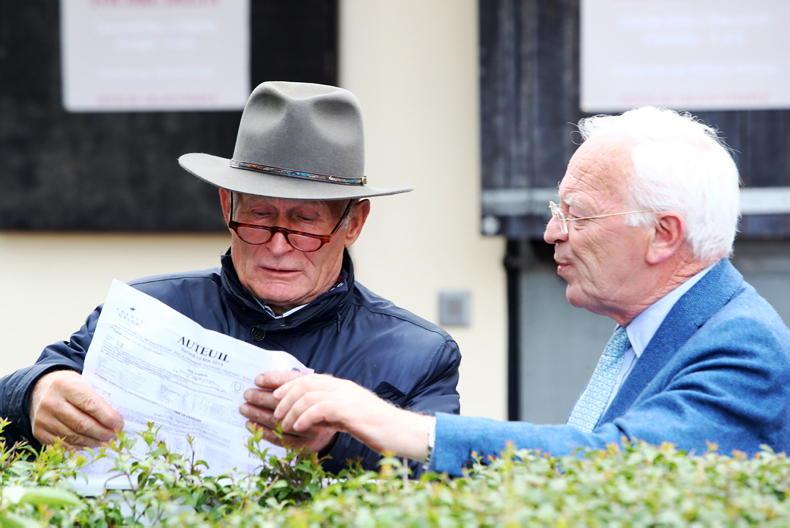
Jean-Pierre Dubois (left) with bloodstock agent Frédéric Sauque
How he made his fortune
The decades that followed were the years during which Dubois built his fortune, eventually becoming one of the largest landowners in Normandy, despite having started with nothing. He achieved this by overturning three long-established traditions of the trotting industry.
The first was that, in trotting, you simply did not sell a good horse. Unlike his competitors, Jean-Pierre Dubois always embraced trading. He worked extensively with the immensely wealthy art dealer Daniel Wildenstein, who, after conquering flat racing, wanted to win the biggest trotting races as well.
Dubois explains: “I have never regretted selling a good horse. The truth is, if I hadn’t sold horses, I would never have been able to buy a house. I sold Queronville LB to a family of gypsies, who had made a fortune in the scrap-metal business. He went on to win major races and people were shocked that I’d sold him. But that sale secured my future. I had a roof over my head.”
Jean-Pierre Dubois’s second masterstroke was the use of American bloodlines. To understand its significance, one must remember that around 80% of French trotting races are restricted to horses registered in the French Trotter Stud Book, a closed population that, for decades, excluded all foreign bloodlines.
Then, in 1987, the Stud Book briefly opened before being closed again by the French authorities. Dubois immediately seized the opportunity. He boarded a plane with his very best mares and took them to leading American stallions - even though he did not actually have the money to pay the stud fees.
He recalls: “My breeding operation was doing reasonably well, but not well enough. I realised something had to change. I’d already spent some time in the United States on a placement with trainer Stanley Dancer. Since I hadn’t spent much time at school, I tried to learn English from a book while I was on the plane.”
Very few French breeders dared to take such a gamble. It proved transformative. Dubois’s Franco-American trotters went on to dominate both the racetrack and the breeding shed for decades.
The closest thoroughbred comparison would be if only a handful of European breeders had gained access to Northern Dancer bloodlines during the 1980s and 1990s.
The Dubois stallions became genuine money-making machines. Love You reached a stud fee of €35,000, while Buvetier d’Aunou and Goetmals Wood also became outstanding commercial successes.
This was where Dubois produced his third stroke of genius. He completely changed the way trotting stallions were syndicated in France by dramatically increasing the number of shares available, multiplying the financial returns generated by his stallions.
Wildenstein influence
The meeting between Daniel Wildenstein, the Ashkenazi art dealer, and Jean-Pierre Dubois, the self-made horseman from rural France, was the encounter of two powerful personalities from entirely different worlds.
At first, they observed one another from a respectful distance. Eventually, they began working together. Before meeting Dubois, Wildenstein had already attempted twice to build a successful trotting stable. Both ventures had failed. Everything changed once Dubois entered the picture.
Together, they won virtually every major race in French trotting. Dubois did not simply sell Wildenstein a horse. Instead, he persuaded him to purchase 50% of his entire annual crop for several consecutive seasons.
Dubois remembers: “There are certain encounters that change your life. In truth, life is nothing but encounters. If you meet the right people, you’re saved. If you meet the wrong ones, you’ve wasted your time.
“Things clicked immediately with Mr Wildenstein. He was extraordinarily generous to me. But you had to get things right. You couldn’t make mistakes or mislead him. He was a remarkable man, incredibly well informed, someone who seemed able to anticipate everything. He hadn’t even seen the horses, yet he already knew everything about them. It was extraordinary.”
Thoroughbred move
Throughout his life, Jean-Pierre Dubois remained fascinated by the Wildenstein thoroughbred breeding operation. Accordingly, he invested much of the money earned from his trotting stallions into building his own thoroughbred broodmare band.
It is therefore no coincidence that Olmedo, winner of the Poule d’Essai des Poulains, Sparkling Plenty, heroine of the Prix de Diane, Sauterne, winner of the Prix du Moulin de Longchamp, and Stacelita, winner of six Group 1 races including the Prix de Diane, all bred by Jean-Pierre Dubois, descend from the same Wildenstein foundation mare: Southern Seas.
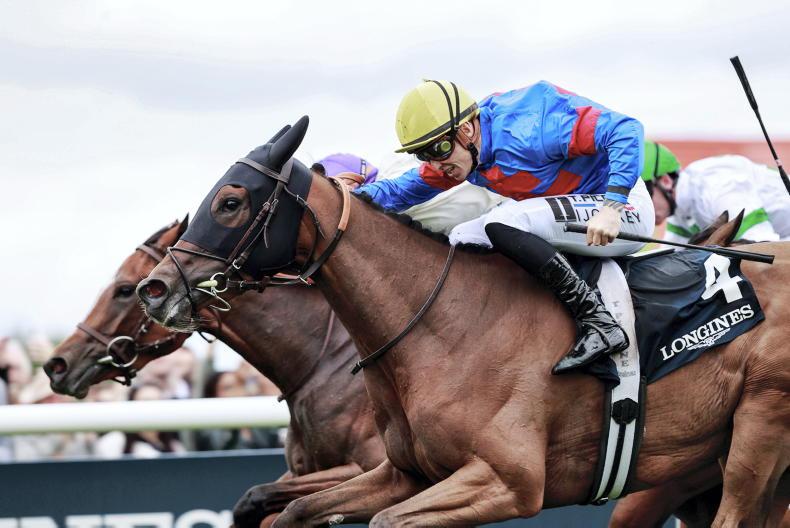
Their sixth dam, Schönbrunn, had originally been purchased by Daniel Wildenstein from Gestüt Schlenderhan. Dubois became so captivated by this famous “S” family that he never stopped buying fillies from the line wherever he could find them.
Many years later, the Goffs team came close to suffering collective heart failure when Sparkling Plenty, winner of the Prix de Diane, was led out of the ring unsold at £8.1 million during the London Sale… before Al Shaqab officially announced that it had purchased a 50% interest in the mare. She returned to the sales ring just a few months later, in December 2024 at Arqana’s December Sale in Deauville. This time, the hammer fell at €5 million. Everything suggests that Dubois has now entered into a partnership with Coolmore.
Remarkable coup
In 2003, Jean-Pierre Dubois pulled off another remarkable coup at Newmarket.
Acting through bloodstock agent Frédéric Sauque, he paid one million guineas for Peinture Rose. Winner of the Listed Prix Cérès, she was, of course, a sister to the champion Peintre Celebre and a member of the celebrated “P” family developed by Wildenstein.
Looking back on the purchase, Frédéric Sauque recalls: “We certainly weren’t the only ones after her. Everybody wanted her. We were bidding against the British, the Irish... but we managed to get her.
“Jean-Pierre Dubois had both the financial resources and the intelligence. He bought nothing but elite pedigrees. He’s more intelligent than the average person and understands things faster than anyone else.
“He’s also the bravest man I’ve ever met. I remember sitting beside him at Newmarket. As the bidding kept climbing, he simply turned to me and said, ‘Come on, let’s keep going’. He absolutely wanted to go home with that mare.”
At one million guineas, Peinture Rose became one of the four most expensive lots of that year’s Newmarket December Mares Sale. But, as Dubois likes to explain, breaking into the very top level of broodmare breeding sometimes means deliberately overpaying. The reward often comes one or two generations later.
The Chachnak story
In the case of Peinture Rose, Jean-Pierre Dubois had to wait a very long time before his investment paid off. It was only at the age of 23 that the mare produced Pink Panthera, runner-up in the Prix de Diane behind Diamond Necklace after recording the fastest closing sectionals of the race.
Like Daniel Wildenstein, Jean-Pierre Dubois has never attached much importance to the age of broodmares. Sometimes, patience is rewarded.
Pink Panthera’s sire, Chachnak, is owned 90% by Dubois, in partnership with his breeder, Hervé Morin, the former French Minister of Defence.
Chachnak was not an outstanding racehorse. He was a solid Group 3 performer in France. However, Dubois has always admired Kingman and his sons, using them extensively in his breeding programme.
Nor was this the first time he had backed a stallion whose race record failed to reflect his own belief in the horse. One remembers Alex The Winner, purchased for $600,000 as a yearling at Keeneland, but who never even made it to the racecourse. Dubois nevertheless supported him heavily at stud, and he eventually sired Zonza, winner of the Group 3 Prix du Bois.
When Chachnak retired to stud, almost everyone thought Dubois had lost his mind. Especially because, following a long-standing trotting tradition, he continued racing the horse after he had already begun covering mares. To date, Chachnak boasts an outstanding 68% winners-to-runners ratio.
Initially, some observers suggested Dubois had manipulated the figures by sending several of the stallion’s offspring to Spain to collect easy victories. In reality, Chachnak has proved to be a genuinely promising sire and covered 125 mares this year.
His four blacktype performers from just 41 flat runners - a strike-rate of almost 10% - have attracted considerable attention from foreign stud farms. Several offers have already been made to purchase him. Jean-Pierre Dubois has rejected every one of them.
Among Chachnak’s best performers are Stolen Kiss, an excellent fourth in the Queen Elizabeth II Jubilee Stakes, Pink Panthera, a narrowly beaten second in the Prix de Diane, and Ginalyah, who was sold to Peter Brant for 800,000gns following her group race performances.
The trader
A tireless worker, Jean-Pierre Dubois has also been highly active in National Hunt racing. He has bred numerous Group 1 winners, from Feu Follet to Salvator Mundi, and it was he who discovered and trained the legendary Kotkijet, widely regarded as the greatest steeplechaser in French history.
In 2005, French television produced a documentary about him. It showed Dubois working day and night, exactly as he had done throughout his life. At one point, the Parisian journalist - visibly exhausted by the cold and the long hours - asked why, despite maintaining such a relentless schedule, he still chose to spend even more time breaking and schooling jumpers?
Dubois replied with his trademark humour: “It’s a hobby. That way, we stay with the horses instead of going to the theatre... We’d be bored to death at the theatre! Here, we’re having fun. We’re happy.”
A few years ago, a young breeder who greatly admired him approached him during a sale and asked whether he happened to have a National Hunt broodmare for sale. Dubois instantly replied: “Of course. What colour would you like?”
Together with his son Jean-Etienne, Jean-Pierre Dubois was also part of the group of daring pinhookers who bought Onesto for $535,000 at the Ocala breeze-up sale. Who spends more than half a million dollars on a two-year-old hoping to make money by racing him?
Yet the gamble proved spectacularly successful. Onesto went on to win the Grand Prix de Paris and also finished on the podium in both the Irish Champion Stakes and the Prix de l’Arc de Triomphe.
Dubois was also among those who purchased Ask For The Moon as a yearling, before she went on to win the Prix Saint-Alary.
The Dubois dynasty
Today, Jean-Pierre Dubois’s children and grandchildren occupy a hugely influential position within French racing, both in trotting and the thoroughbred world.
It begins with his sons, Jean-Etienne and Jean-Philippe, and continues with his grandsons Julien Dubois, Jean Baudron, Louis Baudron - the founder of the auction company Auctav - and Etienne Dubois.
It was Jean-Philippe Dubois who discovered Martinborough in Japan. After making a highly encouraging start as a National Hunt stallion in France, the horse was exported to Ireland to stand at Capital Stud.
Jean-Philippe was also involved, together with partners, in the purchase of Whistlejacket from Coolmore. Both Jean-Philippe and his father Jean-Pierre also played a role in bringing Muhaarar to Normandy.
Father and son consign dozens of yearlings at Arqana every year, notably through Haras des Capucines.
Jean-Philippe is also the breeder of Abraham Lincoln, who sold for €2.3 million at Arqana’s August Sale in Deauville in 2025. Now trained by Aidan O’Brien for Coolmore, the Wootton Bassett colt was beaten by only a short head in the Group 2 July Stakes at Newmarket last month.
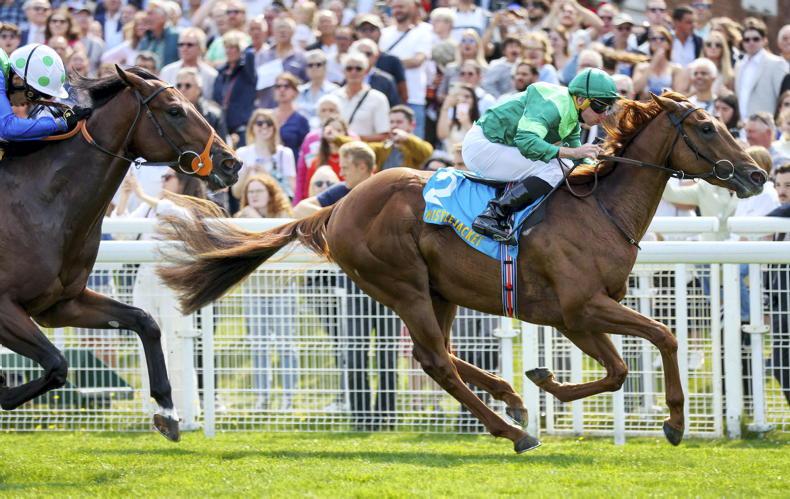
The 2024 Prix Morny winner Whistlejacket was bought to stand in France by a partnership led by Jean-Philippe Dubois, son of Jean-Pierre \ Healy Racing
Jean-Pierre Dubois and his grandson Louis Baudron also pulled off a remarkable coup, when they teamed up to repatriate Triple Threat from the United States. Using their own mares and racing the resulting progeny themselves, the Dubois family took the risk of trying to establish him as a stallion.
Triple Threat quickly sired high-class jumpers before eventually being sold for a substantial sum in Ireland. Jean-Pierre Dubois was also one of the principal shareholders in the outstanding National Hunt sire Martaline, as well as Sageburg, who later stood in Ireland. The Dubois family have always possessed an international outlook.
Jean-Pierre has invested in the United States, Canada and Italy, where he bred Varenne, the trotting equivalent of Frankel.
His son Jean-Etienne settled in Australia, where he bred Aylmerton before selling a 50% interest in the horse to Coolmore in 2018.
Perhaps most remarkably of all, Jean-Pierre Dubois is still driving trotters in races. His latest winner came on May 15th. He is 86 years old!
On several occasions, the French trotting authorities have even been obliged to raise the maximum age limit for drivers, so that he could continue competing.
Reflecting on his extraordinary career, Dubois says: “I try to look at what has worked before. Then I try to trust my instincts and not make too many bad decisions. Because, honestly, my life has been full of mistakes. But every now and then, one idea works... Nowadays, I just want to enjoy myself. I don’t have much time left to do that...”